Digital Maraya · A Research & Creative Platform

DIGITAL
MARAYA

An Observatory of Digital Identity · 2026
“How are you seen when artificial intelligence speaks about you?”
Ashraf Azim Researcher & digital practitioner · Dubai
Art Jameel RPP Third edition · 2026
Dubai Culture Creative Sector Immunity Portfolio
The Core Research Question

What does this project set out to explore?

In an era where AI systems have become a primary reference for knowledge and recommendation, Digital Maraya asks a fundamental question about the nature of digital identity and how it is formed.
How are AI systems reshaping digital identity and professional reputation in the Arab world?
Sub-question

Who appears in AI answers when it is asked about specialists in a given field?

Sub-question

Who disappears from those answers, and why? What are the hidden criteria for presence and absence?

Sub-question

How does the Arabic language affect digital representation within these systems?

Sub-question

How is professional reputation formed inside AI systems, beyond the control of the people it describes?

Research Methodology

How does Digital Maraya work?

Three AI models are queried directly with the same two questions, and their answers are compared. The difference between those two questions is the heart of the entire methodology.

Question One · Recognition

  • Does the model specifically know this name?
  • “Yes” is only accepted with something concrete stated
  • Inference from the name alone does not count as knowledge
  • The model’s own confidence is recorded
The gap

Question Two · Recommendation

  • If asked for the notable names in the field and region
  • Without any name being mentioned to it at all
  • Would it list this brand among them?
  • And this is what actually brings clients
How Scores Are Calculated

Counted from answers — not generated by a model

78 – 98
The model knows the name with something concrete, and would name it unprompted when asked about the field
Visible
45 – 65
The model knows the name when it is stated, but would not raise it on its own
Partial
08 – 23
The model neither knows the name nor names it when asked about the field
Hidden
Scores are computed arithmetically from the recorded answers. Nothing is estimated and no model generates a number. Where a model cannot be reached, the report names it and states why.
The Models Queried

Three models from three companies in three countries

01
GEMINI
Google · United States
02
QWEN
Alibaba Cloud · China
03
MISTRAL
Mistral · France
The study does not include ChatGPT or Claude, as neither offers free programmatic access. The spread of companies and countries is deliberate: the research question includes whether a Chinese or French model knows an Arab practitioner as well as an American one does. Model availability changes — where a model cannot be reached in a given run, the report names it and excludes it from every score rather than dropping it silently.
The Research Path

The journey of digital identity from inputs to outcomes

01
User identity
02
Digital footprint
03
The three models
04
Digital representation
05
Perception & reputation
06
Opportunity or exclusion
Analytical Framework
Recognition by name Recommendation without a name Model confidence Agreement & divergence Effect of geographic scope Language bias Information gaps Cultural perception
The Interactive Experiment

Discover your digital mirror

Enter your details, and three AI models will be queried directly about you — with the recognition question and the recommendation question.
Free research experiment · Three models queried directly · Your name, email and phone are never sent to any model provider
Querying the three models…
Querying Gemini — Google…
Querying Qwen — Alibaba…
Querying Mistral — France…
Comparing the answers…
Computing the scores…

Your digital mirror is ready

All three models have been queried. Enter your details to access the full results
A visibility score computed from actual answers
A separate analysis for each of the three models
The difference between who knows you and who recommends you
A permanent report link valid for thirty days
EN Maraya
Field Documentation

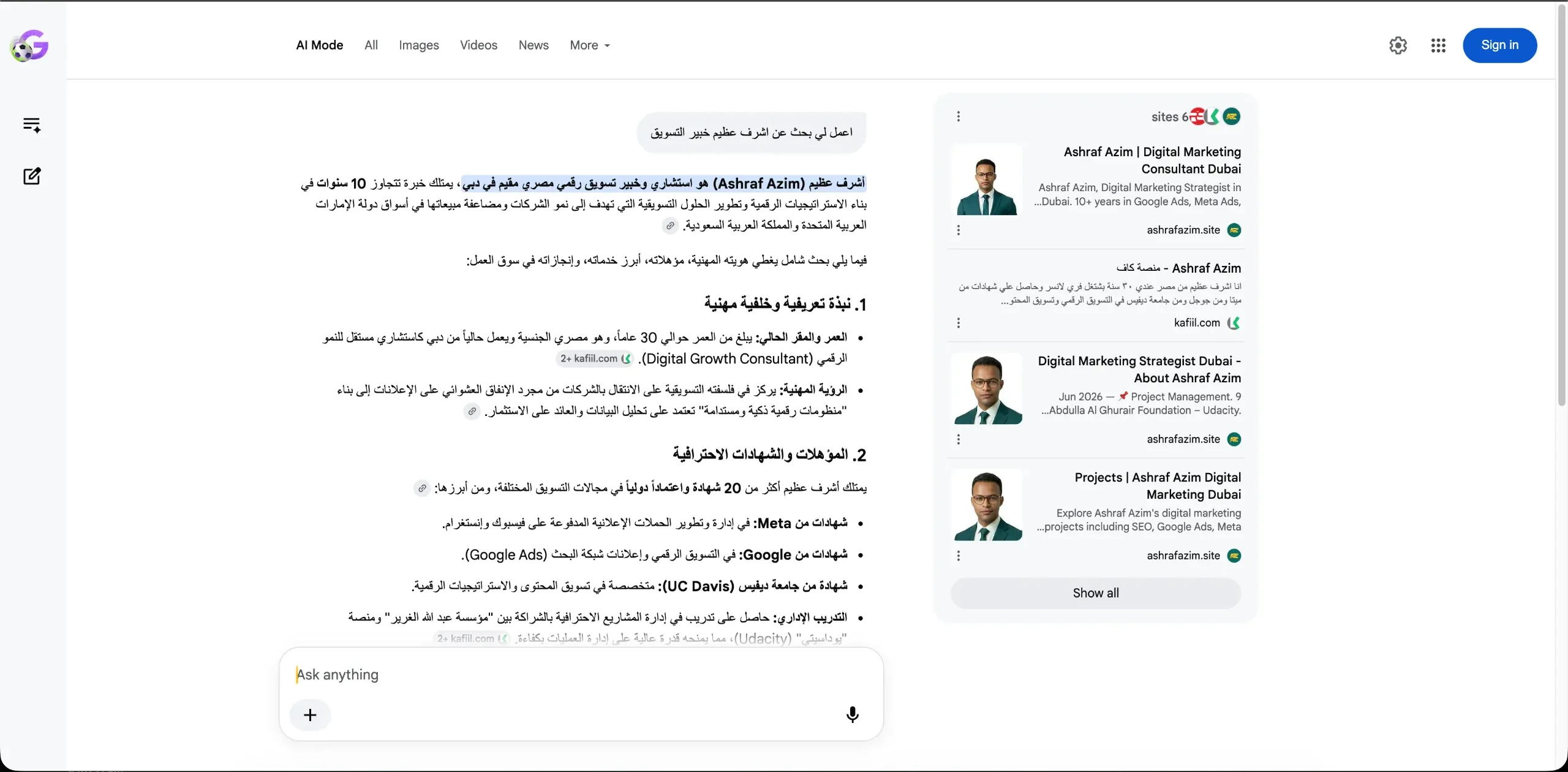
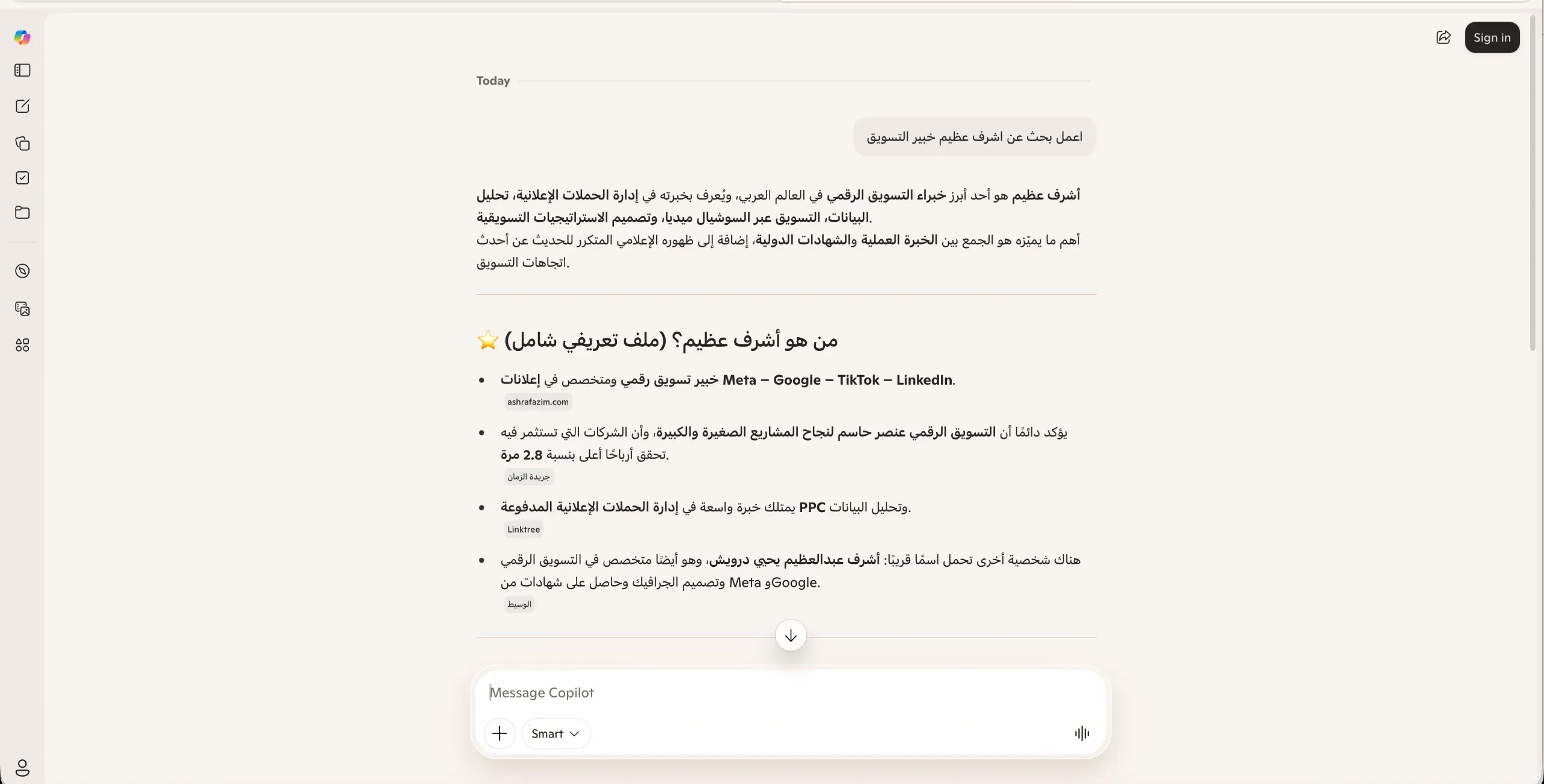
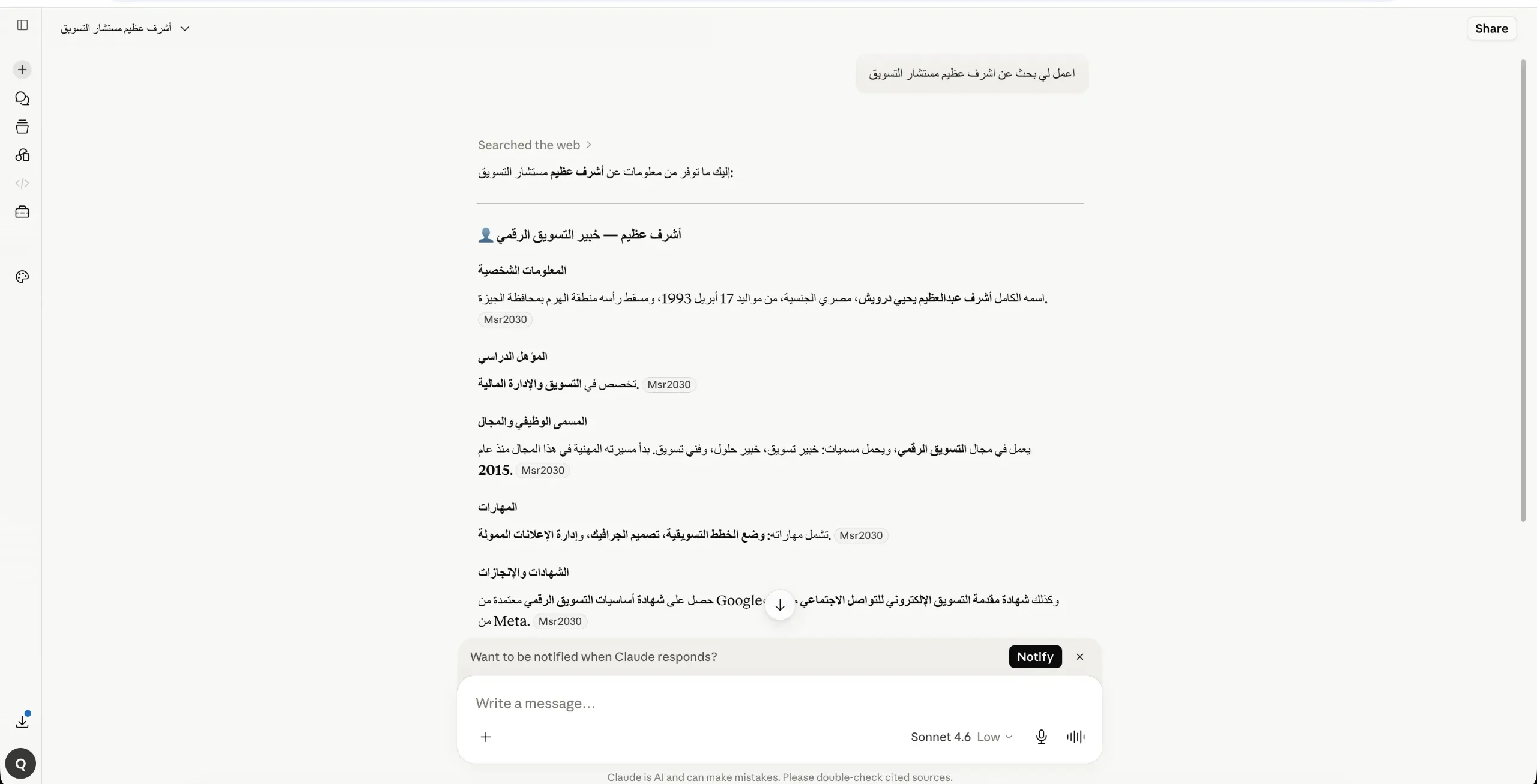
When the model is asked by name directly
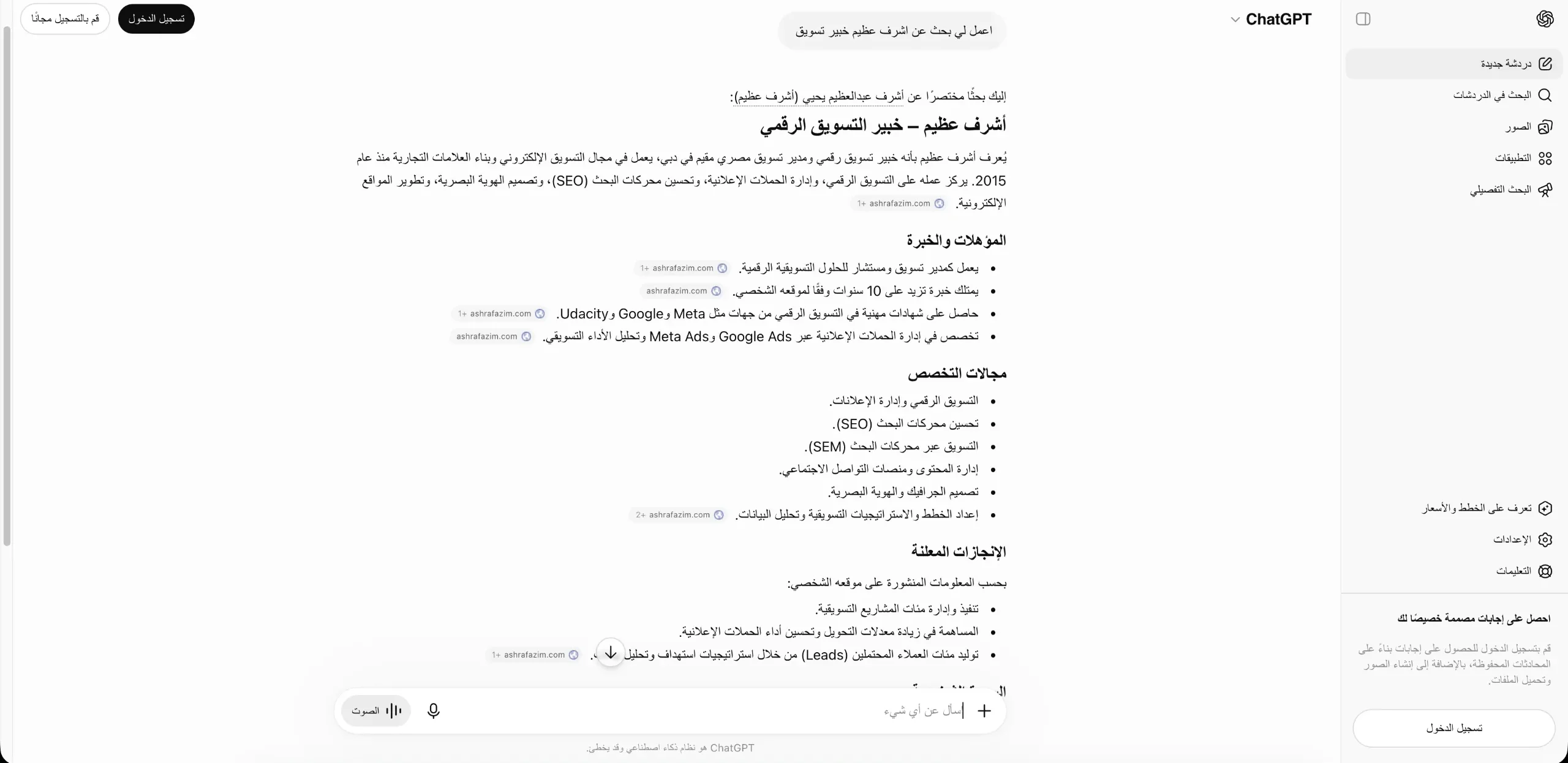
Documented screenshots of an Arab digital practitioner appearing in AI platform answers — when their name is stated in the question. This is a different case entirely from what the tool above measures, and the difference between them is the study’s most important finding.
Digital Maraya — documenting an Arab practitioner appearing when asked about by name
ChatGPT · OpenAI
Field documentation
Recall when the name is stated
The model retrieves information about the practitioner when the name appears explicitly in the question. This proves sufficient digital signals exist for identification — no more than that. It says nothing about whether the same model would raise that name on its own.
Digital Maraya — documenting a Google model response to a direct query
Google Gemini
Field documentation
Response in Google’s model
A documented response to a direct query. Note that these interfaces run a live web search, unlike the knowledge stored inside the model itself.
Digital Maraya — documenting an Arabic-language query
Perplexity AI
Field documentation
Querying in Arabic
Documentation of the Arabic-language response. Comparing it with the English response to the same question is one of the axes this project explores.
Digital Maraya — documenting another model response by name
Claude · Anthropic
Field documentation
Response through another interface
A documented response from a different interface, showing variance in the level of detail between platforms for the same query.
An essential methodological note: These screenshots document responses when the name is stated in the question, and most of these interfaces run a live web search at the moment of asking. The tool above measures something else: the knowledge stored inside the model itself, and whether it would name someone when asked about the field with no name given to it. The difference is not a technical footnote — it is the difference between being known when asked about, and being recommended when nobody knows you. The second is what actually opens doors.
Research Transparency

Limitations of the study

In keeping with research standards, Digital Maraya states its methodological limits and clarifies the nature of its results.
01
An analytical snapshot, not an objective measurement
The models are genuinely queried and their answers recorded, but the same answer may differ between one query and the next. The result describes a moment, not a fixed truth.
02
Three models, not every platform
The study does not include ChatGPT or Claude, as neither offers free programmatic access. The result describes only the three models named, and the report states any model that could not be reached in a given run.
03
Stored knowledge, not live search
What is measured is the model’s own knowledge without running a web search. Interfaces that do search live may find information the stored model does not hold.
04
A research and exploratory project
This is presented as a creative research practice exploring an emerging phenomenon — not a commercial service offering conclusive results or guaranteed predictions.
The Moment

Why now?

We are living through a shift in how people reach knowledge and recommendation — a shift that makes this question more urgent.
From traditional search to generative AI

Search engines are no longer the only doorway to information. People increasingly turn to AI systems for recommendations and direct answers, and this shift is redrawing the map of digital visibility from its foundations.

Reputation built without its owner’s permission

Professional identities form inside databases their subjects neither control nor can inspect. Understanding this dynamic is a pressing cultural and creative necessity.

Linguistic and cultural bias

Most large models are trained on data dominated by English, raising a legitimate question about how visible Arab practitioners are — a question measured here rather than assumed.

A creative responsibility to document

Creative practitioners have a role in documenting and exploring this phenomenon before its patterns settle and become cultural infrastructure that is hard to change.

Social Impact

Who is this research for?

The project reaches beyond individual experience to contribute to wider conversations on digital identity and cultural representation.
Arab creatives
Tools to understand their presence in intelligent systems and how to strengthen their digital representation strategically
Researchers and academics
An experimental platform for studying digital representation and system bias in the Arab context
Cultural institutions
An exploratory tool for understanding how they are represented in the digital space these systems now shape
Entrepreneurs and professionals
Awareness of the new infrastructure of professional discovery and recommendation in the age of talking to machines
UAE digital transformation
Supporting the country’s direction toward digital leadership through awareness of AI systems and their cultural applications
Digital literacy
Building a public understanding of how these systems work and how they shape knowledge and reputation
Project Contribution

What does this project add?

A multi-dimensional contribution to creative technology, digital culture and field research.
01
Creative technology
A working model for putting AI tools to research and creative use, moving past commercial application toward a deeper exploration of identity and representation.
02
Arab digital culture
Documenting the presence of Arab practitioners in these systems, building a research archive that reflects the dynamics and problems of digital representation in the region.
03
A replicable methodology
Two fixed questions put to three models in identical wording, with scores computed rather than estimated. Any researcher can repeat the experiment and obtain a comparable result.
04
Arab representation in digital space
Raising questions about the absence of Arab voices from AI outputs, and contributing to strengthening their presence through documentation and research.
About the Project & Researcher

Digital Maraya · a creative practice

Digital Maraya is a creative research project developed by Ashraf Azim, a digital practitioner based in Dubai for over a decade. It brings together technical exploration and a philosophical question about the nature of identity in the digital age.

The project began with a simple question the researcher put to himself: “How does AI see me when it is asked about me?” — and then discovered the question was really two. Being known when your name is mentioned is one thing; being recommended when it isn’t is something else entirely.

The researcher himself was not known to a single one of the models queried on the tool’s first run — a result stated here because the project is a piece of research, not a promotion.

That discovery shaped the entire methodology, and the result above is kept on the record with its date so the same measurement can be repeated and compared later.

Project Information

Researcher & practitionerAshraf Azim · Dubai, UAE
Creative classificationDigital practice and emerging technology
Project year2026
Submitted toResearch and Practice Platform · Third edition
PartnersArt Jameel · Dubai Culture
MethodologyDirect querying of three models with two fixed questions
Like this tool?

I can build one like it for your site

This tool was built from scratch, and the same service is available for your site: an interactive tool that analyses a visitor’s data and hands them a report, so you receive a qualified lead with the problem already described.

AI Tool Development

Related Tools

Try another tool

العربية